That slight slipping feeling in the rain, a longer stop at a traffic light, or uneven wear you notice in the driveway can all point to the same issue. If you are wondering how to check tread depth, the good news is that it takes only a few minutes and can tell you a lot about how safe your tires still are.
Tread depth matters because it helps your tires grip the road and move water away from the contact patch. As tread wears down, wet-road traction drops, stopping distances can increase, and hydroplaning risk goes up. On dry pavement, a worn tire may still seem usable for a while, which is why many drivers do not catch the problem until weather or road conditions expose it.
Tires do more than roll. They carry the vehicle’s weight, help it corner, and provide the traction needed for braking and acceleration. The grooves in the tread are designed to channel water, slush, and light snow away from the tire. When those grooves get too shallow, the tire cannot do that job as effectively.
This is where numbers matter. In the US, the legal minimum tread depth for passenger tires is 2/32 of an inch. That is the absolute minimum, not the ideal replacement point for everyday safety. Many tire professionals recommend replacing tires earlier than that, especially if you drive often in rain, deal with winter conditions, or carry family and cargo regularly.
A tire at 4/32 inch of tread depth may still be legal, but it is already losing a meaningful amount of wet traction. At 2/32, replacement should not be delayed.
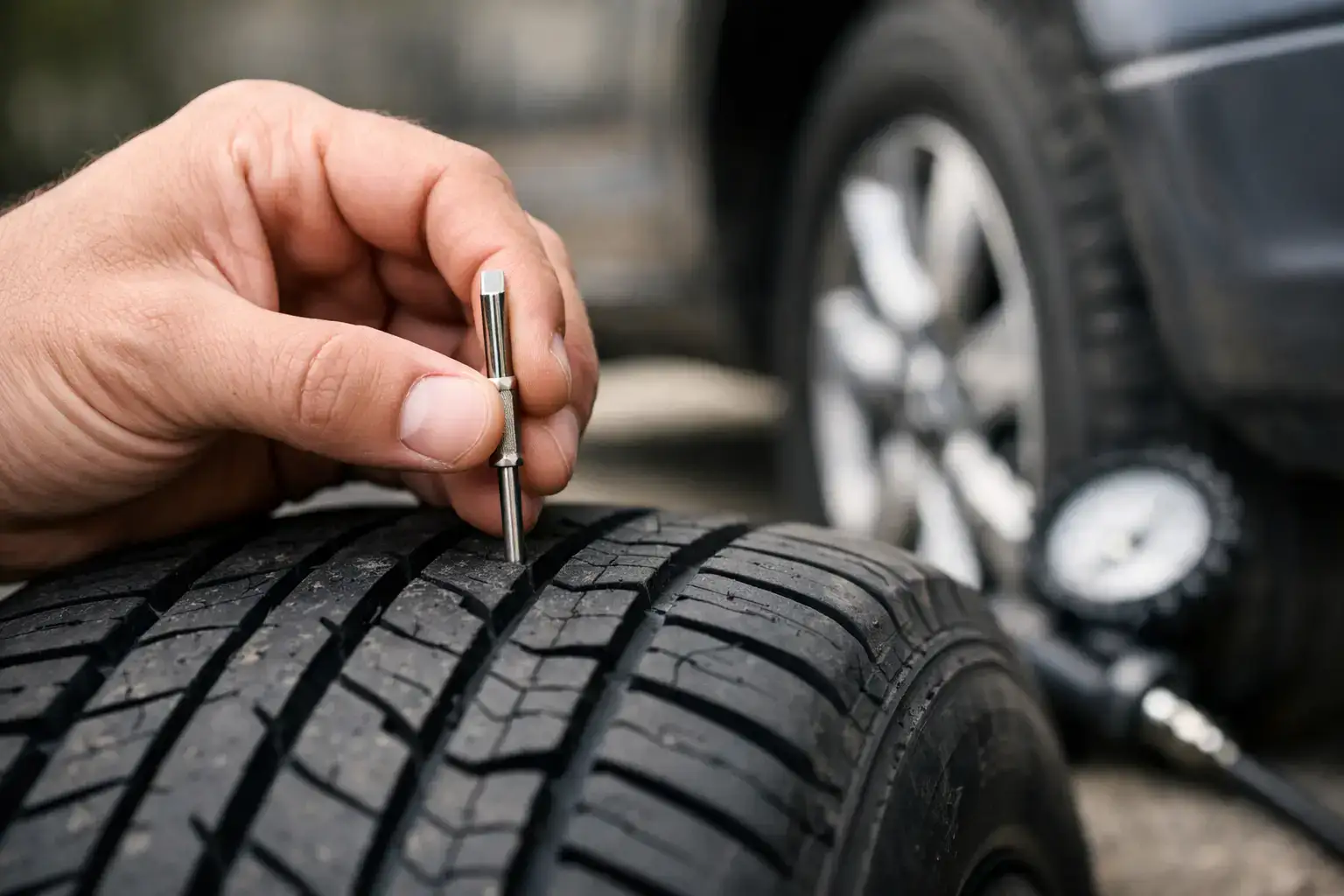
The most accurate way to check tread depth is with a tread depth gauge. They are inexpensive, easy to use, and simple enough for any driver.
Start by parking on a flat surface and turning the steering wheel if needed so you can clearly access the tread. Insert the gauge into one of the main grooves and press the shoulders of the gauge flat against the tread block. Read the measurement where the indicator stops. Then repeat this in several spots across the tire.
Check the inner edge, center, and outer edge of each tire. One reading is not enough because tires often wear unevenly. If the middle is more worn than the edges, overinflation may be the cause. If both edges are more worn than the center, underinflation is a common reason. If one side is wearing faster than the other, alignment or suspension issues may be involved.
If you do not have a gauge, there are still simple ways to get a quick answer.
Most modern tires have tread wear indicators molded into the grooves. These are small raised bars that run across the groove at several points around the tire. When the surrounding tread wears down to the same height as those bars, the tire has reached about 2/32 inch and is ready for replacement.
This method is useful because it does not require any tools, but it tells you only when the tire is at the minimum. It does not help much if you want to catch wear earlier.
The penny test is still one of the most common answers to how to check tread depth without tools. Place a penny into the tread groove with Lincoln’s head upside down and facing you. If part of the top of his head is covered by tread, you still have more than 2/32 inch. If you can see the top of his head fully, the tread is too low.
The penny test is quick, but it has limits. It only checks whether you are above or below the legal minimum. It does not tell you if your tires are at 4/32, where wet-weather performance may already be declining. It is fine for a rough check, but a gauge gives a much clearer picture.
Some drivers prefer a quarter test because it gives a more cautious benchmark. Insert a quarter into a groove with Washington’s head upside down. If the top of his head is covered, you have more than roughly 4/32 inch of tread left.
That does not mean the tire must be replaced immediately if it fails this test, but it does mean you are moving into the range where rain traction may be reduced. For many daily drivers, that is the right time to start planning for new tires rather than waiting.
A tread depth reading is only useful if you know how to interpret it. Here is the practical way to think about it.
At 6/32 inch or more, most passenger tires still have a healthy amount of usable tread for normal driving. At 5/32 to 4/32, tires may still feel fine on dry roads, but wet performance is starting to drop. At 3/32, replacement should be considered urgent. At 2/32, the tire is worn out.
If you use winter tires, the standard is even more cautious. Many drivers replace them around 5/32 or 6/32 because snow traction fades before the tire reaches the legal minimum. A winter tire with low tread may still be technically legal, but it will not perform like a winter tire should.
One of the most common mistakes is checking only the front driver-side tire and assuming the rest are similar. They may not be. Front and rear tires wear differently depending on whether your vehicle is front-wheel drive, rear-wheel drive, or all-wheel drive. Rotations also affect wear patterns.
That is why it is worth measuring every tire in multiple spots. If one tire is significantly lower than the others, there may be a problem beyond normal wear. If two tires on the same axle are wearing very differently, that is another sign to have the vehicle inspected.
Uneven tread depth can affect handling, braking, and ride quality. On some AWD vehicles, differences in tire circumference can also put added stress on the drivetrain. In those cases, replacing one tire instead of a full set may not always be the best option. It depends on the vehicle, the remaining tread on the other tires, and the manufacturer guidelines.
Knowing how to check tread depth is useful, but what the tire tells you matters just as much. If the tread is wearing evenly, that usually points to normal use. If not, the pattern can reveal a lot.
Center wear often suggests too much air pressure over time. Edge wear usually points to underinflation. Feathering or one-sided wear can signal alignment issues. Cupping or patchy wear may come from suspension problems or imbalance.
These issues matter because replacing tires without fixing the cause can lead to the same premature wear on the next set. A tire inspection paired with balancing or alignment service often saves money in the long run.
If your tires are at or below 2/32 inch, replacement should happen now. If they are near 4/32, especially before a rainy season or a long road trip, waiting too long is not a great bet. If you notice visible cracks, bulges, exposed cords, or repeated loss of air pressure, tread depth is no longer the only concern.
Age also matters. A tire can have decent tread left and still need replacement if it is aging out, damaged, or wearing unevenly. That is why a tread reading should be part of the decision, not the whole decision.
For drivers who want a straightforward answer, this is a good rule: if you are checking and hoping the tire is still okay, it may already be time to get a professional opinion. At Migo Tire Corp., that often means helping drivers measure wear, confirm fitment, and choose replacement tires that match how and where they actually drive.
A quick monthly check is a smart habit, and it becomes more important before long trips, during heavy rain seasons, and heading into winter. It also makes sense to check after you notice handling changes, a vibration, or unusual tire wear.
You do not need special expertise to keep up with this. A simple gauge in the glove box and a few minutes in the driveway can give you an early warning before tire wear turns into a safety issue or an unexpected replacement.
Tires rarely fail without giving some kind of signal first. Tread depth is one of the easiest signals to catch, and one of the most useful if you want to keep your vehicle safe and road-ready.